I've recently been thinking about the structural and computational limits of rendering. I've written a lot previously about how this media is rapidly become a key popular orientating mechanism for the future, but unlike print, it obviously has dependencies. Then I was going to write a blog about it, then I wrote a story. ...
-
The flickering lights on the nearby crane, diffused by the thick city air, caught her attention. It was coming up to 9pm and the evening brownout would be up soon with power cut to non-vital services. During winter there were four a day, each for an hour and she was constantly amazed at how quickly the city had adjusted and normalised this dramatic infraction over the last two years. Gazing out of the window over her laptop into the never-dark of the city she glared pointedly at the ever-shifting urban landscape. The rapidity of construction was staggering but it was hard to remember it being any different, adjusted and normalised as everything in the city was.
She examined the site in front of her block; a massive pit of gravel and half-finished foundation that extended to the next street over. Trucks and machinery littered the site and huge halogens illuminated the ground casting harsh and perfectly black shadows under the machines and concrete and wire. All ringed by the defensive palisade of the standard 8 foot construction hoardings. ’What used to be there?’ she wondered. Last week there was one crane, now three, next week… six? Who knew?
She walked past the site and others like it everyday. The buildings grew and changed, were demolished again and rebuilt all over again. The city was pockmarked with pits and piles of rubble and foundations forever. Her streetscape was mostly digital hoardings; glaring and glowing LED screens proclaiming property lifestyle choices. Smiling families catching frisbees in opulent green spaces that never seemed to materialise in the ceaseless churn of construction and deconstruction.
She flicked open a new tab in her browser and went to Street View. Entering the time machine, she scrobbled back through bookmarks from the last few months when the Google cars had been through; hoarding, hoardings, mesh fence, hoardings, hoardings, hoardings.. all the same but different. Eventually she found something. Five years back, the time before the hoardings had arrived. A nondescript, squat concrete block of two or three storeys receded from the road with a ramp leading up to the heavy wooden security door. No indication of what it was. A community centre or hall, maybe some shops or classrooms. It didn’t actually matter. She felt no personal nostalgia for the boring building. It’s just.
It’s just that it’s been five years since anything on this street had been real. Not a promise or a speculation, a future, a rendering or an investment opportunity. A future ever receding behind the CGI towers and greenscape. Five years since that squat concrete bulk of sink-estate architecture had been replaced by ‘City Living With A Wholesome Lifestyle’ or ‘Urban Choices’ or ‘Metropolitan Family Quality’ or ‘Quality. Efficiency. Living’ or ‘Completely Global. Completely Local’ or ‘Live Your Dream’ or ‘Living: Redefined’ or ‘The New Face of Iconic’ or ‘Celebrating Heritage, Creating Opportunity’ or, or, or…
She studied the concrete block on her screen. It sat, blissfully unaware of its fate, obscured by a mix of vegetation and the stretched distortion of the Google car’s camera. The trees were gone for sure. The block eradicated, how was it the same place? Google’s rendering made it so she supposed. Using her mouse, she tried to rotate around and zoom, find out more about the hideous little thing but to no satisfaction. She was stymied by Google’s limited data capture of the time and a generation of architecture that refused to broadcast any intentions.
She looked back out of the window. The hoardings on the site oppostie were still going, looping their kitsch little animations, the gleeful renders and future promises unaware of the brutal power cut on its way. Her laptop battery was charged in advance as always, the blackouts were scheduled and she was well-attuned to making time for them and normally she’d continue through the hour. But. She hesitated.
After a few moments she closed her laptop, put on a coat and left the flat. She descended the stairs and crossed the street.
She concentrated on the hoarding on the other side of the road from her apartment building door. From this perspective she could see none of the concrete foundations, rubble or machinery behind it’s dimming digital glare. In front of gleaming towers, on a glorious sunny day a young woman in sunglasses, gliding down a non-existent gravel path smiled back at her, her hand reached out, she laughed, beckoned and turned around. The CGI view panned up to the sky, the promised apartment towers gleamed in the rendered skybox, constructed from some foreign atmosphere. The view faded to white. ‘Live in Tomorrow’s City.’
She stepped over the road in the chill and quiet and walked over to the hoarding. The animation restarted. The woman walked towards her, smiled, laughed, beckoned, turned, the view panned. ‘Live in Tomorrow’s City.’ Fade to white. The animation restarted.
She moved closer, following the woman’s face as she smiled, laughed, beckoned. ‘Live in Tomrrow’s City.’ Fade to white.
Closer still. She reached out with both hands and touched the dirty surface of the hoarding layered with grime and soot from the street and the site. Smiling, laughing, beckoning. ‘Live in Tomrrow’s City.’ Fade to white.
Closer. Smiling, laughing, beckoning, ‘Live in Tomorrow’s City.’ White.
Closer. The image became blurred, the laughing, the beckoning, the tag line became enmeshed and blurred with the bright LEDs.
She felt the cool plastic of the hoarding touch the tip of her nose. In front of her eyes, a handful of impossibly bright LEDs struggled to maintain focus, blinding her and filling her vision. Somewhere else there was laughing, beckoning, ‘Live in Tomorrow’s City.’ White.
And then just gone. Just black. Her eyes adjusted. Her ears suddenly attuned to the absence of the gentle buzz of electricity. In front of her eyes, the LEDs resolved to dark grey bulbs and she could see the smudged brown of the dirt. No one laughed or beckoned. The future had turned black.
She stepped back, all along the street, the hoardings had cut leaving nothing but grimy screens. She was alone and the street was empty but it was more and less than that. It was empty of itself. As if she was looking at the shell of the street. It came form nowhere and belonged to anywhere. Cracked pavement, unmarked road, black walls. With only the blank LED screens becoming obelisks in her eye line she felt trapped. She looked at her hands, her fingers rubbed with the grime of the LED hoarding. Her hands were grey. She tried to remember the concrete block that stood here five years ago but could only summon Google’s rendering, an overcast day, trees, blurred edges where the software stitched the mediocre panorama into reality. She turned around in the grey, everything suddenly real between renders of past and future.
Then the most brilliant illumination. She saw her hands cast in shadows and white then blues and greens. Colours so bright and real, impossible reality.
Smiling, laughing, beckoning. ‘Live in The City of Tomorrow.’
2.1.17 I, Renderer.
I recently came across Alan Warburton's new short video essay Spectacle, Speculation, Spam, it's pretty comprehensive and understandable breakdown of how software itself is a unifying point of theory and practice. Using the tool as the means of production invites you to theorise on what it means to be using that tool in a critical way. It's worth watching because there's a lot of nuance in the argument and it's something that in my practice I spend a lot of time thinking about. I'm kind of in to opening up and talking about the tools used in art and design production, not in an open-source way but more because I think those tools have an interesting relationship of being shaped and shaping their application. The project I'm working on at the moment is a simulation of a simulation of a machine inside a gallery. I made the conscious decision to very visibly realise what it is to the audience - none of the working will be hidden, nor will the fact that it's essentially just a simulation running on Unity and not a 'real' machine at the highest level. This is a way of opening up the layers of production to the audience, not presenting a spectacle (though I hope it will be spectacular) but as a kind of Pompidou Centre effect.
Art-Labour
Warburton also raises the vexed problem of labour. Though this new project is built in Unity, I didn't build it. I've dabbled in Unity but am nowhere near experienced enough to build what I envisioned to the degree of production I'd be happy with so I've employed someone else and have taken a more directorial role. This is a first for me, I've always done 95% of the labour on my projects - barring extremely specialist services like industrial 3D printing or where assembling a team is necessary like film-making. I was faced with the problem of wanting to do something new and ambitious that was outside my skill set but also not having the time to actually learn those new skills, so I had to bite the bullet and get in someone else.
Rather than a one-way relationship, the result has been a lot of interesting critical conversations between myself and the Unity developer as a result of our understandings of how different software packages work. My 3D software expertise is in Blender (where I would say I'm at a high level of skill) while his in Unity. We've ended up spending a lot of time in discussion about the different ways these software packages work out things like physics, particles and even basics like colours. It's exactly these kind of base level operating structures that I find great points of critical enquiry in working with software: why does Unity render particles such-and-such a way and Blender in such-and-such a way? I'm not going to go into a big software comparison, this isn't that type of blog but it leads to interesting questions about who these packages are for and why they were designed that way and by who? They're both free but in different ways; They both offer similar functions but for different outcomes and so on.
Another interesting point on the problem of art-labour is that I'm working with a developer normally used to games. These games need to be made quick and dirty but look slick and polished. They need to go straight to user's phones and devices so inconsistencies and bugs need to be removed and ironed out. In my work, I'm trying to bring out exactly these software flaws and allow the audience to see the simulation fail and break which I think is a cognitive dissonance for employment, reminding me of Jeremy Hutchinson's Err. project; 'I want you to make something for me but it's fine if it doesn't work.' I've been inviting the developer to leave unintentional flaws in the simulation setup, if it gets stuck or glitches and resets early then that tells us much more about these technologies than faking it does.

Protorenderer
I've never been able to draw (everybody says that and everyone else says that everyone else can draw), I suppose what I mean is; I was always frustrated with my inability at drawing to properly represent my ideas at any more than the most basic, diagrammatic level. When I was at the RCA I decided to play around with 3D printing and a classmate showed me Blender as a way to quickly knock it up. After that I started playing around with it to make my own models of things, not as renders in themselves but as ways to think about objects and their physicality. I enjoyed rotating around them, zooming in, catching different angles and trying to get the thing on screen to fit with what I imagined. This new project, before even hitting Unity had me building a dozen iterations of the setup and functional behaviour in a model of the exhibition space (see above) as a way to think about audience impressions and experience as well as work out very technical constraints like projector throws.

My first render from 88.7 Stories From The First Transnational Traders - 2011-ish?
This is less of a product-design process than a cinematic process. I've always thought about things cinematically and have previously written somewhere or other about how cinematic visuals so easily slip into popular culture and so make a powerful vehicle for designers. The purpose of rendering for me is to get an impression of the thing with one-order of reality removed, as in cinema. The shot above is probably the first render I ever did. It's terrible. But at the time I was overjoyed. It contains millions of faces and only about 3 materials. I teach students Blender and I think one of the hardest conceptual jumps to make is that you're not trying to model reality - you're faking reality. Game engines use this technique all the time with things like clipping distance and object cutoffs to lower processing power on things that are far away. You can't tell from this image but in that glass room at the back are dozens of hand modelled office chairs that no one can ever see but suck up valuable processing time. I had yet to learn my own lessons.
So rendering became a method of prototyping. Most of my projects now involve Blender in some stage of their production, in some, for their entirety. The remake of 88.7 was an entirely rendered 28 minute film and performance. With that project I didn't want to do something that 'represented' the fiction I'd come up with but something that augmented it, offering a more interpretive eye into the characters who's stories I was reading. 'The Manager' is all gold and clockwork, 'The Engineer' a ghostly schematic-like first-person view point, 'The Trader' has a sea of data and we only ever see flickering fluorescent lights for the scientist as she gazes at the ceiling wondering about her situation.
Watching Mephitic Air, made with Wesley Goatley, who's also doing the sound for the new project (another skill and theory set I haven't time to become expert in) is just over 30 minutes of rendered pollution data. Taking something that is classically 'immaterial' (in popular discourse, not reality) and giving it the illusion of materiality which is totally simulated. This influenced our decision to project on thin dust sheets rather than hard projector screens. Walking around it you could never fully grasp the shape of what was happening, just a vague sense of motion and change with the occasional explosion of visuals and sound. The materials are close representations of the substances we were aestheticising at room temperature. Things never normally seen in isolation because they're too small, volatile and diluted, suddenly made hard and irreal.
-
It's also a little bit of a concern of comfort. Through my practice, I've found the tautology that 'you end up doing what you do' really applies. I once spent a year writing and all I got was people asking me to do writing. I now find rendering so comfortable that I seem to always turn to it whenever anything new comes along. That's fine for prototyping but a part of this new project is pushing it aside once it comes to production. Instead of producing a render, which can only ever live on screen or paper, producing an 'artwork' in the fullest sense - with the optimum tools for the ideas, that it's less about the methods of production and what they represent than what the thing is itself. I think my attachment to rendering would make that otherwise impossible. The benefit of unifying practice and theory through the critical use of software (or whatever tools) only goes so far before they start to obfuscate the ideas you're trying to talk about in the first place - yet another difficult balance to strike.
I'm probably going to write and think more about why I render as time progresses and I've done endless little bits of writing on it. It's a hard skill, I wouldn't say there's a rendering package apart form maybe SketchUp that you could pick up and get running with in a day, there's some really interesting conceptual barriers to get round when working with 3D on a 2D screen which lead to difficulties that are more than just learning functionality.
Art-Labour
Warburton also raises the vexed problem of labour. Though this new project is built in Unity, I didn't build it. I've dabbled in Unity but am nowhere near experienced enough to build what I envisioned to the degree of production I'd be happy with so I've employed someone else and have taken a more directorial role. This is a first for me, I've always done 95% of the labour on my projects - barring extremely specialist services like industrial 3D printing or where assembling a team is necessary like film-making. I was faced with the problem of wanting to do something new and ambitious that was outside my skill set but also not having the time to actually learn those new skills, so I had to bite the bullet and get in someone else.
Rather than a one-way relationship, the result has been a lot of interesting critical conversations between myself and the Unity developer as a result of our understandings of how different software packages work. My 3D software expertise is in Blender (where I would say I'm at a high level of skill) while his in Unity. We've ended up spending a lot of time in discussion about the different ways these software packages work out things like physics, particles and even basics like colours. It's exactly these kind of base level operating structures that I find great points of critical enquiry in working with software: why does Unity render particles such-and-such a way and Blender in such-and-such a way? I'm not going to go into a big software comparison, this isn't that type of blog but it leads to interesting questions about who these packages are for and why they were designed that way and by who? They're both free but in different ways; They both offer similar functions but for different outcomes and so on.
Another interesting point on the problem of art-labour is that I'm working with a developer normally used to games. These games need to be made quick and dirty but look slick and polished. They need to go straight to user's phones and devices so inconsistencies and bugs need to be removed and ironed out. In my work, I'm trying to bring out exactly these software flaws and allow the audience to see the simulation fail and break which I think is a cognitive dissonance for employment, reminding me of Jeremy Hutchinson's Err. project; 'I want you to make something for me but it's fine if it doesn't work.' I've been inviting the developer to leave unintentional flaws in the simulation setup, if it gets stuck or glitches and resets early then that tells us much more about these technologies than faking it does.

Protorenderer
I've never been able to draw (everybody says that and everyone else says that everyone else can draw), I suppose what I mean is; I was always frustrated with my inability at drawing to properly represent my ideas at any more than the most basic, diagrammatic level. When I was at the RCA I decided to play around with 3D printing and a classmate showed me Blender as a way to quickly knock it up. After that I started playing around with it to make my own models of things, not as renders in themselves but as ways to think about objects and their physicality. I enjoyed rotating around them, zooming in, catching different angles and trying to get the thing on screen to fit with what I imagined. This new project, before even hitting Unity had me building a dozen iterations of the setup and functional behaviour in a model of the exhibition space (see above) as a way to think about audience impressions and experience as well as work out very technical constraints like projector throws.

My first render from 88.7 Stories From The First Transnational Traders - 2011-ish?
This is less of a product-design process than a cinematic process. I've always thought about things cinematically and have previously written somewhere or other about how cinematic visuals so easily slip into popular culture and so make a powerful vehicle for designers. The purpose of rendering for me is to get an impression of the thing with one-order of reality removed, as in cinema. The shot above is probably the first render I ever did. It's terrible. But at the time I was overjoyed. It contains millions of faces and only about 3 materials. I teach students Blender and I think one of the hardest conceptual jumps to make is that you're not trying to model reality - you're faking reality. Game engines use this technique all the time with things like clipping distance and object cutoffs to lower processing power on things that are far away. You can't tell from this image but in that glass room at the back are dozens of hand modelled office chairs that no one can ever see but suck up valuable processing time. I had yet to learn my own lessons.
So rendering became a method of prototyping. Most of my projects now involve Blender in some stage of their production, in some, for their entirety. The remake of 88.7 was an entirely rendered 28 minute film and performance. With that project I didn't want to do something that 'represented' the fiction I'd come up with but something that augmented it, offering a more interpretive eye into the characters who's stories I was reading. 'The Manager' is all gold and clockwork, 'The Engineer' a ghostly schematic-like first-person view point, 'The Trader' has a sea of data and we only ever see flickering fluorescent lights for the scientist as she gazes at the ceiling wondering about her situation.
Watching Mephitic Air, made with Wesley Goatley, who's also doing the sound for the new project (another skill and theory set I haven't time to become expert in) is just over 30 minutes of rendered pollution data. Taking something that is classically 'immaterial' (in popular discourse, not reality) and giving it the illusion of materiality which is totally simulated. This influenced our decision to project on thin dust sheets rather than hard projector screens. Walking around it you could never fully grasp the shape of what was happening, just a vague sense of motion and change with the occasional explosion of visuals and sound. The materials are close representations of the substances we were aestheticising at room temperature. Things never normally seen in isolation because they're too small, volatile and diluted, suddenly made hard and irreal.
-
It's also a little bit of a concern of comfort. Through my practice, I've found the tautology that 'you end up doing what you do' really applies. I once spent a year writing and all I got was people asking me to do writing. I now find rendering so comfortable that I seem to always turn to it whenever anything new comes along. That's fine for prototyping but a part of this new project is pushing it aside once it comes to production. Instead of producing a render, which can only ever live on screen or paper, producing an 'artwork' in the fullest sense - with the optimum tools for the ideas, that it's less about the methods of production and what they represent than what the thing is itself. I think my attachment to rendering would make that otherwise impossible. The benefit of unifying practice and theory through the critical use of software (or whatever tools) only goes so far before they start to obfuscate the ideas you're trying to talk about in the first place - yet another difficult balance to strike.
I'm probably going to write and think more about why I render as time progresses and I've done endless little bits of writing on it. It's a hard skill, I wouldn't say there's a rendering package apart form maybe SketchUp that you could pick up and get running with in a day, there's some really interesting conceptual barriers to get round when working with 3D on a 2D screen which lead to difficulties that are more than just learning functionality.
12.12.16 The Potential for Radical Politics in Rendering at From Paper to Pixels.
This is the full paper I gave at the From Paper to Pixels; Transmedial Traffic in Architecture Drawing at the Jaap Bakema Study Centre, TU Delft in association with The New Institute, Rotterdam. It's useful in laying out some of my thoughts about rendering as a potential practice for radical imagination. This is the full 3,700 words including the abstract, I've included some of the slides but not all of them. My apologies.
Because of their dominance, projects of resistance cite these renders as targets. Campaigns attempting to halt redevelopment, gentrification or expensive public-private projects hold up these renders as leitmotif effigy, symbols of the top-down power the renders represent.
However, the growing accessibility and usability of rendering software presents an alternative space for political action. Rather than simply becoming sites of resistance, rendering software has the potential to be a site of radical, critical imagination. As Nick Srnicek and Alex Williams point out in their book ‘Inventing the Future’ - We ‘can’t resist new worlds into being’ [Srnicek & Williams 2015] but we can begin to render new worlds as alternative visions that wildly challenge the dominant hegemony of rendered futures.
Activists and artists have begun to use rendering software as a tool for creating new imaginaries and feeling critical debate about the shaping of the future. Their projects challenge histories, the laws of physics and create sprawling meta-fictions that exceed the abilities of other media. At the same time these projects make tongue-in cheek attacks at the narratives and aesthetics of architectural rendering and dominant power structures.
This paper lays out a brief analysis of the relationship between future imaginaries and the dominant aesthetics of contemporary rendering software and suggests that this software presents a space for developing political imaginaries that can lead change and critical discussion. It uses examples and case studies from theorists and artists working in the space of 3D rendering to lay out a framework for where these kinds of practices might start to exist and act and suggests tactics and techniques for a new radical culture of rendering.

The self-appointed role of Superstudio as an architecture firm remains contentious since not a single one of their instantly recognisable designs was ever built. There are compelling arguments [Elfline, 2016] that the work that Superstudio pursued sat within the context of the leftist politics of the time and that they, like other critical practitioners both contemporary and historical, created obstructions to encourage disruption and engagement rather than buildings that continued the neoliberal hegemony they despised. Whether they created or obstructed, Superstudio recognised that the work of architecture is no more in construction than music is in getting to the end of a song. The work of architecture, design, art and all those fields with the privilege of creativity and critique is in building future imaginaries - renders of the way the world might be, orientating visions of future material products that ‘enchant’ our future.

In this way, architecture uses drawings, plans and increasingly, renders to materialise the future and present it to their audience. People relate to the built world first through its rendering before its construction. In 2015, when controversy surrounded the funding and construction of Thomas Heatherwick’s Garden Bridge in London, it had yet to exist. The future imaginary used was one of two or three renders of the bridge. It became the object around which public debate formed [Di Salvo, 2009] despite being, culturally at least, entirely imaginary.
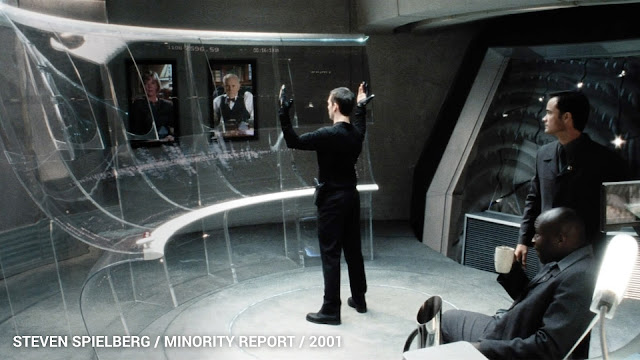
Human material culture is riddled with future imaginaries. Cinema perhaps leads this field and several studies have pointed out how the penetration and resolution of these imaginaries feeds back into reality [Bassett et al. 2013]. Stephen Spielberg’s 2001 film, Minority Report is a particularly pertinent example. The fictional and completely rendered gestural interface used by Tom Cruise has held sway over 15 years of interface development and technology headlines. As rendering becomes a faster and more affordable alternative to expensive sets and protracted film shoots, television and advertising are following suit. Almost all car adverts in print and moving image are rendered, in 2014, 75% of IKEA catalogue images were 3D renders [Parkin, 2014]. The benefits of this approach are obvious, rendering is cheap, affordable, quickly iterative and allows of circumventing external factors: For example, the troublesome laws of physics. In 3D-rendering, dramatic sunrises can be made to last forever over perfect and empty mountain roads.

The danger is that we are limiting our imagination by creating a homogenous rendered visual culture. Buildings on development hoardings begin to look identical, cars and sofas have the same haptics. The developing visual language of 3D rendering is becoming self-reinforcing in its aspirations. We run the risk of a visual Shazam effect for rendered images.[Thompson, 2014] The Shazam effect, named for the music recognition software, is a phenomena whereby record companies produce music based on the download habits of users thus creating a reinforcing cycle of all music sounding the same. Rendering software developers increasingly develop tools and processes of their software around the demands of some of their biggest clients - architects and advertisers - creating a self-reinforcing aesthetic loop. The 3D digital artist Matthew Plummer-Fernandez claimed once in an interview to be able to recognise the software used to render buildings based on the ‘off-the shelf’ algorithms and plugins [Plummer-Fernandez, 2014].

A very real example of the Shazam effect in play is the work of Crystal CG, a Beijing-based rendering company who offer ‘fast turnaround, high quality and inspiring presentations, including 3D renderings, animations, multimedia and virtual reality.’ The website is packed with identikit steel and glass structures brooding under dramatic sunsets with the requisite amount of shadow-people render ghosts and street greenery to make an appealing frontispiece to any development hoarding. Their partners and clients are almost every major developer, several Olympic development projects and a range of ultra-rich micro-nations. The chances are you’ve seen some of their work and if not one of Crystal CG’s renderings then one of their competitors’.
The visual language epitomised by Crystal CG is thoroughly embedded in visual culture, at least in richer parts of the world. These developments could be anywhere, they are after all produced by artists who have never visited the sites in question and probably know very little of the local culture. They simply materialise a set of plans into something visually appealing and striking. However, the sheer onslaught of this aesthetic is becoming the steering narrative for what the future should be. In a recent trip to Colombo, Sri Lanka, I had a conversation with a representative of a redevelopment group building a massive office and shopping complex in the heart of the city. When I pointed out that the building looked like it could be from anywhere and asked who had created the render he said that he didn’t know… ‘some Chinese company.’

Looking at the rendered city sets of sci-fi films like Elysium and Star Wars reveals an aesthetic continuum between the hyper-real development renderings that pervade the city and how we imagine the future city to be. The rise of white and gleaming tower i inevitable as is the kitsch homage to the 70s utopian visions of space life. As if to concretise this relationship between urbanists, rendering artists and games developers, a 2014 project between city-developers and game-developers created rendered imaginaries of how Britain might look in the 22nd century showing cities like Manchester as hyper-real assemblages of placeless architecture and fantasy technology [Clarkson, 2014].
The future is imagined through these visual artefacts, and as they become more and more identical we run the significant risk of reducing our range of imagination. We might end up building an aesthetic cage in which we find it impossible to imagine a future beyond the gleaming towers and rendered greenery, in which the 45-degree skyline view becomes all encompassing and we dream of endless sunsets over our glass balconies.
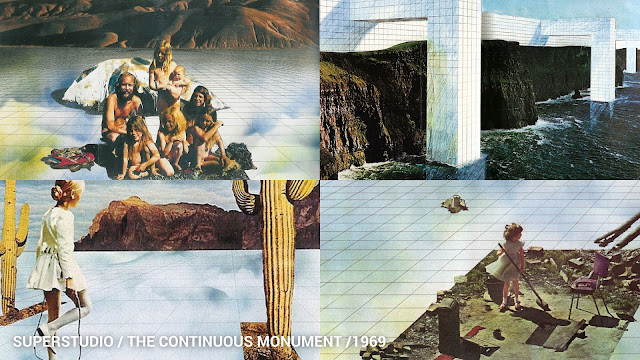
In the late 1960’s Superstudio cannily seized on the cultural penetration that visual culture allows to seed alternative future imaginaries to what they saw as a visual hegemony. Their projects were visually rich and dizzying, playing into the language of cinema, collage and colour photography to inject a counter-narrative into popular culture. They realised, through exhibition and publication the reach of their work and how to play with these tools to introduce new ideas and critique. With the prevalence of rendering tools in contemporary culture, we can start to draw parallels with other contemporary practices and see how artists are using the tools of luxury flat renderings to build alternatives or critique the aesthetic hegemony we have.
The English word ‘render’ finds its etymology in the Latin ‘reddere’ - to ‘give back’ from which we also get the English word ‘redeem.’ So, in the spirit of redeeming myself I want to suggest an exceptionally loose categorisation of radical approaches to rendering largely from outside the architecture world: Un-Rendering, Low-Rendering and Hyper-Rendering. These categories are structured by the tactics that practices used to achieve the objective of engaging audiences in critical debate. In Un-Rendering we find practices trying to undo the render, to uncover the underlying technical reality of the rendering produced. Low-Rendering practices use intentionally low-resolutions, simplified, distorted and ambiguous imagery to encourage audiences to critically imagine the wider context of the work or the specifics of its functioning. And in Hyper-Rendering practitioners push the technical boundaries of rendering software and materials to create radical aesthetic imaginaries that critique the homogeneity of the rendered landscape. These practice create Overton-Window effects, introducing extreme and radical ideas in order to try and stretch the standard deviation of styles. I’ve also referred almost exclusively to practices outside what could be considered architecture. These practices are artists seizing the tools of architects to do other things, to think and act in non-architectural ways.

Crystal Bennes’ archiving project #developmentaesthetics aims to ‘chronicle the rise and rise of the inane language and visuals used to market new buildings and developments in London (and increasingly across the UK).’ [Bennes, 2013] By presenting photographed images on a blog with almost no commentary, she flattens them and removes them from the context of glamour and aspiration in which they are supposed to be contextualised. By presenting them together she encourages us to draw comparisons between the aesthetics and language of contemporary architecture and development and critique the hegemony of the renders and hyperbole that surrounds them. Dan Hill’s similarly archival ongoing project Noticing Planning Notices serves to draw attention to the role of planning notices in civic engagement with development. He makes the point that ‘…the primary interface between the UK’s planning system and the people and places it serves is a piece of A4 paper tied to a lamppost in the rain.’ Rather than renderings serving as the main means of public engagement with the future of their cities, he extols a better understanding of planning processes as the ‘dark matter’ of future city development.

More radically, the artist Hito Steyerl, in her 2013 video work, How Not to be Seen: A Fucking Didactic Educational .MOV File highlights some of the technical limitations of rendering software. She tells us that ‘to become invisible, one has to become smaller or equal to one pixel.’ By playing to the aesthetic of pixel orientation markers, green-screening, rendering and satellite photography, she suggests ways that we might uses chromakeying and other technical processes to subvert the rendered and computer visible world and challenge renders on their own terms - unrendering ourselves. She also offers her own critique of rendered future imaginaries, citing the gated and exclusive communities of developers and describing how they enable invisibility and un-rendering for the ultra-rich at the other end of the spectrum.

In Dunne and Raby’s 2013 project, United MicroKingdoms, the UK has been split into four allegorical political and economic systems: Digtiarians, a society governed by algorithms with a mobile-phone tariff style economy; Communo-Nuclearists, a zero-sum communitarian economy based on the near limitless energy supplied by nuclear power; Bio-Liberals, a techno-utopia social democracy based on synthetic biological technology and Anarcho-Evolutionists, an anarchist society based on self-augmentation and experimentation. Rather than represent these speculative societies through complex RAND-style diagrams, masterplans and papers, the designers created vehicles used by the citizens; driverless robocars for the Digitarians, a nuclear-powered train disguised as landscape for the Communo-Nuclearists, slow biological machine cars for the Bio-Liberals and a communal bicycle for the Anarcho-Evolutionists.
The aesthetics of the vehicles presented are themselves low-resolution, with simplistic designs and pastel colours. They’re not meant to reflect the technical demands or limitations of the technologies but the wider contextual system of politics in which they’re embedded. Similar in detail and sheen to how the background of architecture renderings often appear, (non-descript grey or white blocks fading into the software’s clipping distance.) the models and images of United MicroKingdoms serve as tools for thought and boundary marking rather than outcomes in their own right.
In Superflux’s 2015 film Uninvited Guests, a similar tactic is used. Ostensibly a design fiction about a ‘smart’ future, the film’s technological devices - a walking stick, a fork and a bed - all variously connected to the Internet and sharing data are intentionally shown in low-resolution as generic fluorescent yellow objects with no detail to put them out of the ordinary as objects in themselves.

Matthew Plummer-Fernandez’s 2015 Peak Simulator builds a physical mountain range from the same algorithm used in early computer-generated landscapes. By then physicalising and placing this landscape in a real landscape, he highlights the dissonance between the computer-generated world at low resolution and the real. The leap in complexity between what could be said to be the ‘infinite resolution’ of the ‘real world’ and how the landscape can be made to appear on screen dismantles the spectacle of the rendering and shows it for the fabrication it really is as well as demonstrating how this type of generic landscape is technically generated.
Low-rendering practices use intentionally ‘under-developed’ material and visual qualities to draw the audience away from the specifics of the materials, objects and technologies they are talking about and to think critically about the processes and contexts that have created and supported them. In the case of Superflux and Dunne and Raby this is to draw the viewer away from the specifics of the technology and into wider contextual discussions. In the case of Plummer-Fernandez, this is to draw the audience away form the spectacle of procedurally-processed computer generated landscapes and into the reality of their technical construction and their un-real nature.

Lawrence Lek’s 2015 Unreal Estate (The Royal Academy is Yours) uses the Unity game engine to imagine a future Royal Academy in London that has been bought by a Chinese oligarch. The hyper-real fantasy of Lek’s Royal Academy defies all aesthetic sensibilities, great works of modern art are gathered and flung haphazardly around the garishly painted space. The space has been militarised and a private helicopter sits on the roof. Lek suggests that this is the way the ultra-rich see the world, as a decontextualised game space to be reconfigured at will. Sascha Pohflepp and Chris Woebken’s 2016 The House in The Sky uses similar rendering techniques to critique society’s upper echelons. Based off photographs, they recreated the mid-20th century home of top RAND strategists and re-staged the discussion rumoured to have happened there. In playing with ideas of modelling and representations through rendering they critique the top-down ideology of RAND strategists during the founding period of neoliberal strategising.
Both of these practices use rendering as an embedded part of their critique. Using the hyper-real properties of rendering software to interpret the unimaginable and impenetrable worlds of the elite and represent them in a performative way that somehow embodies their approaches - form the abstracted world-renderings of RAND strategists to the game-like fantasies of the ultra-rich.
Playing more with the simulative potential of rendering software, Berlin studio Zeitguised produce stunning hyper-real animations that defy physical laws and exist in another realm previously unimagined. Zeitguised position themselves somewhere between arts and fashion though their work exists entirely in digital form. Most of their clients are advertisers who look to them for a rendered aesthetic that’s a little more edgy than their competitors but in their work is a glimpse of the possibility of rendering software - to completely refigure physical laws and create total fantasies that exceed the bounds of a perfected future-present. Another project of Pohflepp and Woebken’s, Island Physics is a curated digital installation of artists working with the open-source rendering software Blender. The artists play with the potential of augmented reality and Blender’s physics simulations to create impossible visual spectacles that fill the exhibition space. As much a technical demonstration of the ability of open source software, it’s also a precursor to its potential to do radically different forms of rendering to those scene on development hoardings around the world.

Another pertinent yet unrealised potential for radical rendering is in virtual reality. Here the opportunity for immersive counter-future-imaginaries is huge but largely undeveloped. A notable exception is A Short History of the Gaze by Molleindustria, a virtual reality game where users occupy the gaze in notable cultural moments form the panopticon to a French boulevard. The project is a clever double-header playing with the idea of looking and seeing and being seen with the new reality-blindness of virtual reality.
Hyper-Rendering practices use the rendering software itself as the basis for critique and imagination. Rather than a tool to be circumvented as in un-rendering or used for critical discussion as in low-rendering, it in itself is vital to the projects and practices of hyper-rendering. As rendering software and it’s attendant technologies like virtual reality cheapens and accessibility and literacy grows we might expect to see a growth in practices using hyper-real rendering methods to create new imaginaries and develop political critiques. It is in hyper-rendering where we might find a contemporary equivalent to the approach of Superstudio, seizing the tools normally used to reinforce the aesthetic hegemony over future imaginaries and turning it to new purposes.
What these practices, and the hundreds like them present is another way that the tools of rendering might be used to create alternative future imaginaries or to challenge the existing ones, to broaden our aesthetic range and thus our range of future imaginaries.
Bassett C., Steinmueller E., Voss G., (2013) Better Made Up: The Mutual Influence of Science fiction and Innovation, Nesta working paper
Bennes, C., (2013) #DevelopmentAesthetics, tumblr http://developmentaesthetics.tumblr.com
Clarkson, N., (2014) How Might Space Travel Change Our Cities, Virgin. https://www.virgin.com/disruptors/how-might-space-travel-change-our-cities
Di Salvo, C., (2009) Design and th Construction of Publics, Design Issues: Volume 25, Number 1 Winter 2009, MIT Press
Hill, D., (2015) Noticing Planning Notices, author’s blog, http://www.cityofsound.com/blog/2015/04/planning-notices.html
Parkin, K., (2014) Building 3D with Ikea, CGSociety, http://www.cgsociety.org/index.php/CGSFeatures/CGSFeatureSpecial/building_3d_with_ikea
Plummer Fernandez, M. ,(2014) ‘You can spot what software has been used to design a building’, Dezeen, https://www.dezeen.com/2014/10/17/movie-matthew-plummer-fernandez-you-can-spot-software-design-building/
Ross K. E., (2016) Superstudio and the “Refusal to Work”, Design and Culture, 8:1, 55-77
Srnicek, N., Williams, A., (2015) Inventing the Future: Postcapitalism and a World without Work, New York: Verso Books
Thompson, D., (2014) The Shazam Effect, The Atlantic http://www.theatlantic.com/magazine/archive/2014/12/the-shazam-effect/382237/
Abstract
Architectural renders form the cornerstone of public communication in contemporary architecture. New developments are reported and promoted to the public using highly stylised glamorous and romantic renders that conform to the dominant societal values and politics: aspiration, wealth, executive and family lifestyles, urbanism. This consequently results in an homogenous aesthetic. Rendering software and its application works as a self-reciprocating aesthetic style of tropes that reinforce these dominant politics and values. Images of the future reinforce the way that future is developed [Bassett et al. 2013] and so in creating these renders, developers and architects build a narrow and linear vision of the future in line with the values they espouse. In tun, the software is further developed to reinforce these tropes. [Plummer Fernandez 2014]Because of their dominance, projects of resistance cite these renders as targets. Campaigns attempting to halt redevelopment, gentrification or expensive public-private projects hold up these renders as leitmotif effigy, symbols of the top-down power the renders represent.
However, the growing accessibility and usability of rendering software presents an alternative space for political action. Rather than simply becoming sites of resistance, rendering software has the potential to be a site of radical, critical imagination. As Nick Srnicek and Alex Williams point out in their book ‘Inventing the Future’ - We ‘can’t resist new worlds into being’ [Srnicek & Williams 2015] but we can begin to render new worlds as alternative visions that wildly challenge the dominant hegemony of rendered futures.
Activists and artists have begun to use rendering software as a tool for creating new imaginaries and feeling critical debate about the shaping of the future. Their projects challenge histories, the laws of physics and create sprawling meta-fictions that exceed the abilities of other media. At the same time these projects make tongue-in cheek attacks at the narratives and aesthetics of architectural rendering and dominant power structures.
This paper lays out a brief analysis of the relationship between future imaginaries and the dominant aesthetics of contemporary rendering software and suggests that this software presents a space for developing political imaginaries that can lead change and critical discussion. It uses examples and case studies from theorists and artists working in the space of 3D rendering to lay out a framework for where these kinds of practices might start to exist and act and suggests tactics and techniques for a new radical culture of rendering.
Introduction
Speaking at London’s Architecture Association in 1971, Adolfo Natalini, founder of the radical architecture firm Superstudio presented an argument for Superstudio’s withdrawal from the work of architecture - producing buildings.
The self-appointed role of Superstudio as an architecture firm remains contentious since not a single one of their instantly recognisable designs was ever built. There are compelling arguments [Elfline, 2016] that the work that Superstudio pursued sat within the context of the leftist politics of the time and that they, like other critical practitioners both contemporary and historical, created obstructions to encourage disruption and engagement rather than buildings that continued the neoliberal hegemony they despised. Whether they created or obstructed, Superstudio recognised that the work of architecture is no more in construction than music is in getting to the end of a song. The work of architecture, design, art and all those fields with the privilege of creativity and critique is in building future imaginaries - renders of the way the world might be, orientating visions of future material products that ‘enchant’ our future.

In this way, architecture uses drawings, plans and increasingly, renders to materialise the future and present it to their audience. People relate to the built world first through its rendering before its construction. In 2015, when controversy surrounded the funding and construction of Thomas Heatherwick’s Garden Bridge in London, it had yet to exist. The future imaginary used was one of two or three renders of the bridge. It became the object around which public debate formed [Di Salvo, 2009] despite being, culturally at least, entirely imaginary.

Human material culture is riddled with future imaginaries. Cinema perhaps leads this field and several studies have pointed out how the penetration and resolution of these imaginaries feeds back into reality [Bassett et al. 2013]. Stephen Spielberg’s 2001 film, Minority Report is a particularly pertinent example. The fictional and completely rendered gestural interface used by Tom Cruise has held sway over 15 years of interface development and technology headlines. As rendering becomes a faster and more affordable alternative to expensive sets and protracted film shoots, television and advertising are following suit. Almost all car adverts in print and moving image are rendered, in 2014, 75% of IKEA catalogue images were 3D renders [Parkin, 2014]. The benefits of this approach are obvious, rendering is cheap, affordable, quickly iterative and allows of circumventing external factors: For example, the troublesome laws of physics. In 3D-rendering, dramatic sunrises can be made to last forever over perfect and empty mountain roads.

The danger is that we are limiting our imagination by creating a homogenous rendered visual culture. Buildings on development hoardings begin to look identical, cars and sofas have the same haptics. The developing visual language of 3D rendering is becoming self-reinforcing in its aspirations. We run the risk of a visual Shazam effect for rendered images.[Thompson, 2014] The Shazam effect, named for the music recognition software, is a phenomena whereby record companies produce music based on the download habits of users thus creating a reinforcing cycle of all music sounding the same. Rendering software developers increasingly develop tools and processes of their software around the demands of some of their biggest clients - architects and advertisers - creating a self-reinforcing aesthetic loop. The 3D digital artist Matthew Plummer-Fernandez claimed once in an interview to be able to recognise the software used to render buildings based on the ‘off-the shelf’ algorithms and plugins [Plummer-Fernandez, 2014].

A very real example of the Shazam effect in play is the work of Crystal CG, a Beijing-based rendering company who offer ‘fast turnaround, high quality and inspiring presentations, including 3D renderings, animations, multimedia and virtual reality.’ The website is packed with identikit steel and glass structures brooding under dramatic sunsets with the requisite amount of shadow-people render ghosts and street greenery to make an appealing frontispiece to any development hoarding. Their partners and clients are almost every major developer, several Olympic development projects and a range of ultra-rich micro-nations. The chances are you’ve seen some of their work and if not one of Crystal CG’s renderings then one of their competitors’.
The visual language epitomised by Crystal CG is thoroughly embedded in visual culture, at least in richer parts of the world. These developments could be anywhere, they are after all produced by artists who have never visited the sites in question and probably know very little of the local culture. They simply materialise a set of plans into something visually appealing and striking. However, the sheer onslaught of this aesthetic is becoming the steering narrative for what the future should be. In a recent trip to Colombo, Sri Lanka, I had a conversation with a representative of a redevelopment group building a massive office and shopping complex in the heart of the city. When I pointed out that the building looked like it could be from anywhere and asked who had created the render he said that he didn’t know… ‘some Chinese company.’

Looking at the rendered city sets of sci-fi films like Elysium and Star Wars reveals an aesthetic continuum between the hyper-real development renderings that pervade the city and how we imagine the future city to be. The rise of white and gleaming tower i inevitable as is the kitsch homage to the 70s utopian visions of space life. As if to concretise this relationship between urbanists, rendering artists and games developers, a 2014 project between city-developers and game-developers created rendered imaginaries of how Britain might look in the 22nd century showing cities like Manchester as hyper-real assemblages of placeless architecture and fantasy technology [Clarkson, 2014].
The future is imagined through these visual artefacts, and as they become more and more identical we run the significant risk of reducing our range of imagination. We might end up building an aesthetic cage in which we find it impossible to imagine a future beyond the gleaming towers and rendered greenery, in which the 45-degree skyline view becomes all encompassing and we dream of endless sunsets over our glass balconies.
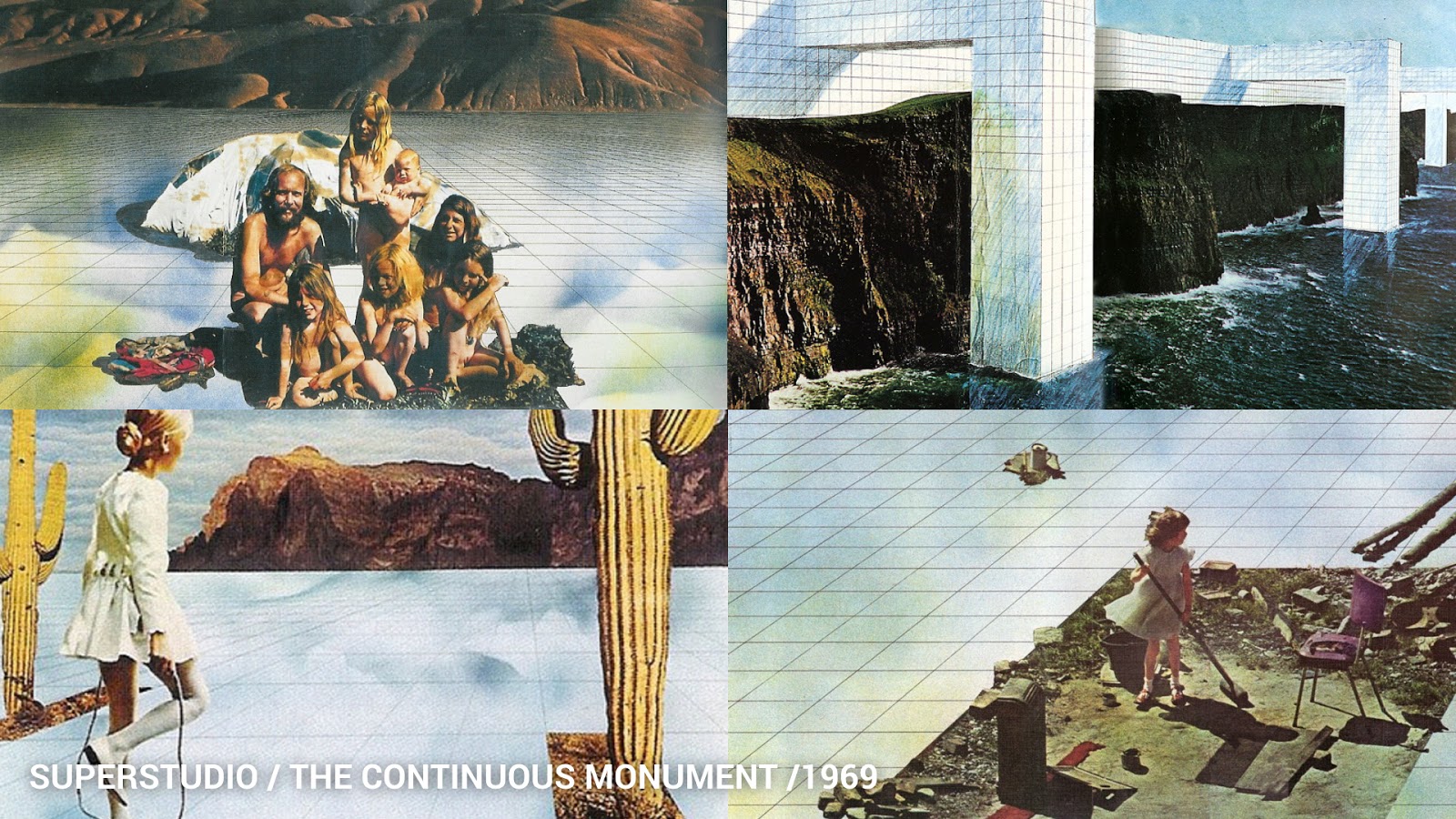
In the late 1960’s Superstudio cannily seized on the cultural penetration that visual culture allows to seed alternative future imaginaries to what they saw as a visual hegemony. Their projects were visually rich and dizzying, playing into the language of cinema, collage and colour photography to inject a counter-narrative into popular culture. They realised, through exhibition and publication the reach of their work and how to play with these tools to introduce new ideas and critique. With the prevalence of rendering tools in contemporary culture, we can start to draw parallels with other contemporary practices and see how artists are using the tools of luxury flat renderings to build alternatives or critique the aesthetic hegemony we have.
The English word ‘render’ finds its etymology in the Latin ‘reddere’ - to ‘give back’ from which we also get the English word ‘redeem.’ So, in the spirit of redeeming myself I want to suggest an exceptionally loose categorisation of radical approaches to rendering largely from outside the architecture world: Un-Rendering, Low-Rendering and Hyper-Rendering. These categories are structured by the tactics that practices used to achieve the objective of engaging audiences in critical debate. In Un-Rendering we find practices trying to undo the render, to uncover the underlying technical reality of the rendering produced. Low-Rendering practices use intentionally low-resolutions, simplified, distorted and ambiguous imagery to encourage audiences to critically imagine the wider context of the work or the specifics of its functioning. And in Hyper-Rendering practitioners push the technical boundaries of rendering software and materials to create radical aesthetic imaginaries that critique the homogeneity of the rendered landscape. These practice create Overton-Window effects, introducing extreme and radical ideas in order to try and stretch the standard deviation of styles. I’ve also referred almost exclusively to practices outside what could be considered architecture. These practices are artists seizing the tools of architects to do other things, to think and act in non-architectural ways.
Un-Rendering
Underlying any rendering we find a host of systemic conditions and requirements; the intermeshed complexities of planning, logistics, legal restrictions, engineering and infrastructure. The rendered image normally used for public consumption is the sharp end of this long and expensive sword. Practices of unrendering seek to investigate and reveal what is behind the rendering, to trace the thread of reality that the fantasy render is tied to.
Crystal Bennes’ archiving project #developmentaesthetics aims to ‘chronicle the rise and rise of the inane language and visuals used to market new buildings and developments in London (and increasingly across the UK).’ [Bennes, 2013] By presenting photographed images on a blog with almost no commentary, she flattens them and removes them from the context of glamour and aspiration in which they are supposed to be contextualised. By presenting them together she encourages us to draw comparisons between the aesthetics and language of contemporary architecture and development and critique the hegemony of the renders and hyperbole that surrounds them. Dan Hill’s similarly archival ongoing project Noticing Planning Notices serves to draw attention to the role of planning notices in civic engagement with development. He makes the point that ‘…the primary interface between the UK’s planning system and the people and places it serves is a piece of A4 paper tied to a lamppost in the rain.’ Rather than renderings serving as the main means of public engagement with the future of their cities, he extols a better understanding of planning processes as the ‘dark matter’ of future city development.

More radically, the artist Hito Steyerl, in her 2013 video work, How Not to be Seen: A Fucking Didactic Educational .MOV File highlights some of the technical limitations of rendering software. She tells us that ‘to become invisible, one has to become smaller or equal to one pixel.’ By playing to the aesthetic of pixel orientation markers, green-screening, rendering and satellite photography, she suggests ways that we might uses chromakeying and other technical processes to subvert the rendered and computer visible world and challenge renders on their own terms - unrendering ourselves. She also offers her own critique of rendered future imaginaries, citing the gated and exclusive communities of developers and describing how they enable invisibility and un-rendering for the ultra-rich at the other end of the spectrum.
Low-Rendering
Low-rendering intentionally challenges the spectacle of the hyper-real. Rather than presenting complete worlds of smiling residents, playing and working in a perfectly lit and maintained space, low-renders show only a framework or an idea and invite the audience to sketch out the details, often drawing their own conclusions as to the purpose and function of the plan.
In Dunne and Raby’s 2013 project, United MicroKingdoms, the UK has been split into four allegorical political and economic systems: Digtiarians, a society governed by algorithms with a mobile-phone tariff style economy; Communo-Nuclearists, a zero-sum communitarian economy based on the near limitless energy supplied by nuclear power; Bio-Liberals, a techno-utopia social democracy based on synthetic biological technology and Anarcho-Evolutionists, an anarchist society based on self-augmentation and experimentation. Rather than represent these speculative societies through complex RAND-style diagrams, masterplans and papers, the designers created vehicles used by the citizens; driverless robocars for the Digitarians, a nuclear-powered train disguised as landscape for the Communo-Nuclearists, slow biological machine cars for the Bio-Liberals and a communal bicycle for the Anarcho-Evolutionists.
The aesthetics of the vehicles presented are themselves low-resolution, with simplistic designs and pastel colours. They’re not meant to reflect the technical demands or limitations of the technologies but the wider contextual system of politics in which they’re embedded. Similar in detail and sheen to how the background of architecture renderings often appear, (non-descript grey or white blocks fading into the software’s clipping distance.) the models and images of United MicroKingdoms serve as tools for thought and boundary marking rather than outcomes in their own right.
In Superflux’s 2015 film Uninvited Guests, a similar tactic is used. Ostensibly a design fiction about a ‘smart’ future, the film’s technological devices - a walking stick, a fork and a bed - all variously connected to the Internet and sharing data are intentionally shown in low-resolution as generic fluorescent yellow objects with no detail to put them out of the ordinary as objects in themselves.

Matthew Plummer-Fernandez’s 2015 Peak Simulator builds a physical mountain range from the same algorithm used in early computer-generated landscapes. By then physicalising and placing this landscape in a real landscape, he highlights the dissonance between the computer-generated world at low resolution and the real. The leap in complexity between what could be said to be the ‘infinite resolution’ of the ‘real world’ and how the landscape can be made to appear on screen dismantles the spectacle of the rendering and shows it for the fabrication it really is as well as demonstrating how this type of generic landscape is technically generated.
Low-rendering practices use intentionally ‘under-developed’ material and visual qualities to draw the audience away from the specifics of the materials, objects and technologies they are talking about and to think critically about the processes and contexts that have created and supported them. In the case of Superflux and Dunne and Raby this is to draw the viewer away from the specifics of the technology and into wider contextual discussions. In the case of Plummer-Fernandez, this is to draw the audience away form the spectacle of procedurally-processed computer generated landscapes and into the reality of their technical construction and their un-real nature.
Hyper-Rendering
Hyper-rendering builds on and exploits the techniques and technologies of renderings to push aesthetic boundaries towards new future imaginaries and to critique power. These practices intentionally subvert the real world and push the hyper-real nature of commercial rendering to new extremes to draw out their absurdity or to develop new ways of critiquing.
Lawrence Lek’s 2015 Unreal Estate (The Royal Academy is Yours) uses the Unity game engine to imagine a future Royal Academy in London that has been bought by a Chinese oligarch. The hyper-real fantasy of Lek’s Royal Academy defies all aesthetic sensibilities, great works of modern art are gathered and flung haphazardly around the garishly painted space. The space has been militarised and a private helicopter sits on the roof. Lek suggests that this is the way the ultra-rich see the world, as a decontextualised game space to be reconfigured at will. Sascha Pohflepp and Chris Woebken’s 2016 The House in The Sky uses similar rendering techniques to critique society’s upper echelons. Based off photographs, they recreated the mid-20th century home of top RAND strategists and re-staged the discussion rumoured to have happened there. In playing with ideas of modelling and representations through rendering they critique the top-down ideology of RAND strategists during the founding period of neoliberal strategising.
Both of these practices use rendering as an embedded part of their critique. Using the hyper-real properties of rendering software to interpret the unimaginable and impenetrable worlds of the elite and represent them in a performative way that somehow embodies their approaches - form the abstracted world-renderings of RAND strategists to the game-like fantasies of the ultra-rich.
Playing more with the simulative potential of rendering software, Berlin studio Zeitguised produce stunning hyper-real animations that defy physical laws and exist in another realm previously unimagined. Zeitguised position themselves somewhere between arts and fashion though their work exists entirely in digital form. Most of their clients are advertisers who look to them for a rendered aesthetic that’s a little more edgy than their competitors but in their work is a glimpse of the possibility of rendering software - to completely refigure physical laws and create total fantasies that exceed the bounds of a perfected future-present. Another project of Pohflepp and Woebken’s, Island Physics is a curated digital installation of artists working with the open-source rendering software Blender. The artists play with the potential of augmented reality and Blender’s physics simulations to create impossible visual spectacles that fill the exhibition space. As much a technical demonstration of the ability of open source software, it’s also a precursor to its potential to do radically different forms of rendering to those scene on development hoardings around the world.

Another pertinent yet unrealised potential for radical rendering is in virtual reality. Here the opportunity for immersive counter-future-imaginaries is huge but largely undeveloped. A notable exception is A Short History of the Gaze by Molleindustria, a virtual reality game where users occupy the gaze in notable cultural moments form the panopticon to a French boulevard. The project is a clever double-header playing with the idea of looking and seeing and being seen with the new reality-blindness of virtual reality.
Hyper-Rendering practices use the rendering software itself as the basis for critique and imagination. Rather than a tool to be circumvented as in un-rendering or used for critical discussion as in low-rendering, it in itself is vital to the projects and practices of hyper-rendering. As rendering software and it’s attendant technologies like virtual reality cheapens and accessibility and literacy grows we might expect to see a growth in practices using hyper-real rendering methods to create new imaginaries and develop political critiques. It is in hyper-rendering where we might find a contemporary equivalent to the approach of Superstudio, seizing the tools normally used to reinforce the aesthetic hegemony over future imaginaries and turning it to new purposes.
Conclusion
Rendering software is at the root of much of the visual culture that surrounds us everyday and its penetration is increasing, from cinema and architecture to advertising and sales imagery. As a tool it is largely used to prop up an existing aesthetic hegemony that makes imagining alternative futures hard. We run the risk of a Shazam effect, where the aesthetic of rendered futures self-replicates and we are unable to imagine alternatives.What these practices, and the hundreds like them present is another way that the tools of rendering might be used to create alternative future imaginaries or to challenge the existing ones, to broaden our aesthetic range and thus our range of future imaginaries.
Bassett C., Steinmueller E., Voss G., (2013) Better Made Up: The Mutual Influence of Science fiction and Innovation, Nesta working paper
Bennes, C., (2013) #DevelopmentAesthetics, tumblr http://developmentaesthetics.tumblr.com
Clarkson, N., (2014) How Might Space Travel Change Our Cities, Virgin. https://www.virgin.com/disruptors/how-might-space-travel-change-our-cities
Di Salvo, C., (2009) Design and th Construction of Publics, Design Issues: Volume 25, Number 1 Winter 2009, MIT Press
Hill, D., (2015) Noticing Planning Notices, author’s blog, http://www.cityofsound.com/blog/2015/04/planning-notices.html
Parkin, K., (2014) Building 3D with Ikea, CGSociety, http://www.cgsociety.org/index.php/CGSFeatures/CGSFeatureSpecial/building_3d_with_ikea
Plummer Fernandez, M. ,(2014) ‘You can spot what software has been used to design a building’, Dezeen, https://www.dezeen.com/2014/10/17/movie-matthew-plummer-fernandez-you-can-spot-software-design-building/
Ross K. E., (2016) Superstudio and the “Refusal to Work”, Design and Culture, 8:1, 55-77
Srnicek, N., Williams, A., (2015) Inventing the Future: Postcapitalism and a World without Work, New York: Verso Books
Thompson, D., (2014) The Shazam Effect, The Atlantic http://www.theatlantic.com/magazine/archive/2014/12/the-shazam-effect/382237/
4.12.16 The Finite-State Fantasia 1
I’ve been chipping away at a commission for the last few months which isn’t yet announced but I’d like to write about nonetheless. (You may have seen in my last missive that I promised my PhD supervisor I’d write about what I was doing and why. Hereby I announce a return to regular blogging. Although I only get time to sit in front of a computer while travelling so I join you from the Eurostar.) Part of this process is to bring together all the disparate aspects of what I’m doing into something I can practice and work through and someday call a PhD. Consequently, this post serves as something of a rationalisation of how it ties in to a lot of the things I’ve been doing over the 12 months-ish, especially as I try and figure out what my practice is for the next 5 years.
I’m going to introduce and try and frame some of the areas of my research interests and what I”m doing about it before introducing the plan for the project in the next post and hoping, student-like, to document the process of its growth over the next few months here before finally reflecting on what happened and how it worked. Or not.

While at a panel discussion last night Nicolas Nova prodded me on what the importance of this type of ‘hauntological’ thinking is and why it works. From where it stands now I can see three reasons for the appeal. Firstly, it’s using the tools of the master against them. It’s an out-and-out seizing of the narrative of ‘magic’ and ‘enchantment’ that occupy popular and corporate narratives about what technology is and what it’s for. When that world that you’re trying to critique turns to those metaphors it feels only apt to do the same as if to stretch the analogy even further.
Secondly, magic and the occult has deep and powerful and well-proven ties to politics and powers structures. Skipping over for a moment, all the complex anthropology about what spiritualism and the supernatural actually are, there’s no doubt that they have been used as levers of power in different ways. I’m currently engaged in reading about the classification and examination of Japanese ‘wonder’ in the 19th century and finding the narrative dominated by the politics of a gradually-opening Japan a neat parallel to many political shifts today.
Thirdly, it’s a method of examining ’cultural assimilation.’ I can’t remember where I originally heard the phrase I now use almost daily (I suspect, like most other things Gell) but using the occult as a metaphor is a powerful way of breaking cognitive barriers to have livelier and critical discourses. Whatever your cultural background, we all have a conception of ‘magic’ where we might not have one of ‘packet switching’ or even something ‘ownership.’ A recent paper I read pointed out the ludicrousness of abstract concepts like ‘the market,’ ‘the cloud’ and ‘publics’ being acceptable forms of decision-making orientating bodies but magic, the spiritual and the supernatural which has as equally real and present artefacts and effects being excluded.
But at the route of Haunted Machines is a critique of dominant narratives of technology, seizing a narrative to build powerful analogies to challenge the loudest voices of progress, innovation, disruption etc. etc. etc. So I don’t suppose Haunted Machines is about the occult any more than Animal Farm is about agricultural technologies. Haunted Machines is about power, design, art, technology and the outsider as well as how, for my conception of it, machines are becoming totems of power that dazzle us with trickery.
Briefly: Rendering software has largely been the preserve of cinema, advertisers and architects. Consequently, these fields which generally lack much in the way of quality wider social critique (sorry architects, it’s true, you know it, I know it) have the monopoly on visualising and imagining the future. Either they need to get better at pluralising or we need more renders. There’s loads of artists and other practitioners starting to do this and I’ve been keeping my eye out for more. The other interesting point of renders is the actual technical methodology. The computing power required to create believable realities is shrinking rapidly. I could create an image that would fool you into thinking it was real in minutes. This has drastic implications of fields critiquing technology and culture. I point you to the return of Moriarty in Star Trek TNG. Not only could this present an enormous power lever for deceit and trickery but it leads to a genuine question I’ve posed before elsewhere.

Additionally, technically the process is very interesting. Rendering only works at close-high resolution. I could create a 10m x 10m tile of water pretty realistically but it doesn’t scale. The trick only works close up. The haptic and materiality of it are really dynamic and interesting and counterintuitive. Light doesn’t really work the way you think it does, air is really important. Things aren’t made the same surfaces you thought they were. Wesley Goatley explored this a little bit in Watching Mephitic Air, but I keep coming back to the very real material and technical qualities of rendering software as sites of technological critique. There’s also dialogue between how machines see and then create that works through rendering (lit. ‘to redeem/return’) where how a machine ‘builds’ a model of the world is an aspect of its perception of it.
For now, I’m buying into the theory proposed by Herman von Helmholtz that the brain is a ‘prediction machine:’ The model of the world we have and consciously hold is a ‘best guess’ based on available information. Getting chewy about these words is important (and Goatley specifically chews me out about getting them wrong.) Information is the reduction of uncertainty. Senses are input devices and perception is where these senses are integrated into a model. In fact, several theories attempting to solve the ‘hard problem’ of consciousness propose that consciousness exists simply as integrated perception in animals. We don’t see colour and form as separate and see an object as integrated in all our senses where a machine senses them as separate points.
But the words don’t fit, the stories aren’t right. To be honest a fair bit of me is getting annoyed with ‘machine vision’ projects that show nothing more than the debugging screen. What is the ontological experience of being a machine? Even the word ‘experience’ and ‘ontological’ are problematic here. Can I affect a first-person sympathetic perspective of the machine? Is it worth it?
The point is to tackle a major thrust of my PhD work - that treating ‘smart’ and ‘networked’ objects as if they are more gadgets and office furniture isn’t good enough. It isn’t good enough for things that act on your world and have their own ‘worldview’ (no they don’t, I know) to be glossed over ‘as magical’ while being so many different things to so many different agents. It isn’t good enough for things that you don’t ‘wholly’ own in the Japanese sense of in where you can’t comprehend the entire chain of cause and effect that might dictate actions. Machines exist as 'not-nothings' things that aren't conscious and humans but things that aren't simply tools or other objects. It's reconciling their 'not-nothingness' with how we build our perceptions of them into a lived experience that more often than not delivers them as 'non-integrated perceptive cognates' that I'm going to try and do.
Magic and Technology
This new project initially started as a response to some of the thinking about technology and the occult I’ve been doing, mostly under the guise of Haunted Machines. This ongoing project with Natalie Kane is currently in its largest and most ambitious manifestation - as a year-long program of event throughout 2017 centred on the Impakt festival in Utrecht, Netherlands. Of course, I have to work out what exactly it is about this line of thinking that appeals to me beyond it’s obvious aesthetic appeal.While at a panel discussion last night Nicolas Nova prodded me on what the importance of this type of ‘hauntological’ thinking is and why it works. From where it stands now I can see three reasons for the appeal. Firstly, it’s using the tools of the master against them. It’s an out-and-out seizing of the narrative of ‘magic’ and ‘enchantment’ that occupy popular and corporate narratives about what technology is and what it’s for. When that world that you’re trying to critique turns to those metaphors it feels only apt to do the same as if to stretch the analogy even further.
Secondly, magic and the occult has deep and powerful and well-proven ties to politics and powers structures. Skipping over for a moment, all the complex anthropology about what spiritualism and the supernatural actually are, there’s no doubt that they have been used as levers of power in different ways. I’m currently engaged in reading about the classification and examination of Japanese ‘wonder’ in the 19th century and finding the narrative dominated by the politics of a gradually-opening Japan a neat parallel to many political shifts today.
Thirdly, it’s a method of examining ’cultural assimilation.’ I can’t remember where I originally heard the phrase I now use almost daily (I suspect, like most other things Gell) but using the occult as a metaphor is a powerful way of breaking cognitive barriers to have livelier and critical discourses. Whatever your cultural background, we all have a conception of ‘magic’ where we might not have one of ‘packet switching’ or even something ‘ownership.’ A recent paper I read pointed out the ludicrousness of abstract concepts like ‘the market,’ ‘the cloud’ and ‘publics’ being acceptable forms of decision-making orientating bodies but magic, the spiritual and the supernatural which has as equally real and present artefacts and effects being excluded.
But at the route of Haunted Machines is a critique of dominant narratives of technology, seizing a narrative to build powerful analogies to challenge the loudest voices of progress, innovation, disruption etc. etc. etc. So I don’t suppose Haunted Machines is about the occult any more than Animal Farm is about agricultural technologies. Haunted Machines is about power, design, art, technology and the outsider as well as how, for my conception of it, machines are becoming totems of power that dazzle us with trickery.
Rendering
I’ve been talking about rendering and CGI for a little while. I’m by no means an expert and my skill level is incomparable to other practitioners but I’ve been noticing that I’ve been using it more and more in my practice and have, through doing so, been thinking about why. The obvious appeal is in its ease of use. With Blender as a free platform, even with a steep learning curve, one can be producing good quality images and animation quite quickly and cheaply. This in itself is a major point of interest. I presented a paper at TU Delft last week, which I’ll publish on here in the next week or so, in which I discussed the potentials for such an amazing tool outside of its current applications.Briefly: Rendering software has largely been the preserve of cinema, advertisers and architects. Consequently, these fields which generally lack much in the way of quality wider social critique (sorry architects, it’s true, you know it, I know it) have the monopoly on visualising and imagining the future. Either they need to get better at pluralising or we need more renders. There’s loads of artists and other practitioners starting to do this and I’ve been keeping my eye out for more. The other interesting point of renders is the actual technical methodology. The computing power required to create believable realities is shrinking rapidly. I could create an image that would fool you into thinking it was real in minutes. This has drastic implications of fields critiquing technology and culture. I point you to the return of Moriarty in Star Trek TNG. Not only could this present an enormous power lever for deceit and trickery but it leads to a genuine question I’ve posed before elsewhere.
Additionally, technically the process is very interesting. Rendering only works at close-high resolution. I could create a 10m x 10m tile of water pretty realistically but it doesn’t scale. The trick only works close up. The haptic and materiality of it are really dynamic and interesting and counterintuitive. Light doesn’t really work the way you think it does, air is really important. Things aren’t made the same surfaces you thought they were. Wesley Goatley explored this a little bit in Watching Mephitic Air, but I keep coming back to the very real material and technical qualities of rendering software as sites of technological critique. There’s also dialogue between how machines see and then create that works through rendering (lit. ‘to redeem/return’) where how a machine ‘builds’ a model of the world is an aspect of its perception of it.
What’s it doing?
This is the final and biggest part for this specific project. And I think it ties particularly into Haunted Machines. The brief of this project is about trying to de-mistify the magic, fear and horror around seemingly intelligent, autonomous objects by getting inside the machine. What is the world when you have only infra-red sensors with a range of 1.5m that flash 67 times second returning two discrete data points? A totally non-integrated sensorium. Our work in Haunted Machines has shown over and over again that we create narratives that animate devices, systems and services in order to make sense of the cognitive phenomena of machines we are totally and utterly incapable of comprehending. The perfect focal point for this idea is the question ‘What’s it doing?’ A question you probably ask quite regularly, sometimes even gendering it with ‘What’s he/she doing?’ At this exact point we alot agency, will and, I suspect, at the back of our minds, consciousness to the machine.For now, I’m buying into the theory proposed by Herman von Helmholtz that the brain is a ‘prediction machine:’ The model of the world we have and consciously hold is a ‘best guess’ based on available information. Getting chewy about these words is important (and Goatley specifically chews me out about getting them wrong.) Information is the reduction of uncertainty. Senses are input devices and perception is where these senses are integrated into a model. In fact, several theories attempting to solve the ‘hard problem’ of consciousness propose that consciousness exists simply as integrated perception in animals. We don’t see colour and form as separate and see an object as integrated in all our senses where a machine senses them as separate points.
But the words don’t fit, the stories aren’t right. To be honest a fair bit of me is getting annoyed with ‘machine vision’ projects that show nothing more than the debugging screen. What is the ontological experience of being a machine? Even the word ‘experience’ and ‘ontological’ are problematic here. Can I affect a first-person sympathetic perspective of the machine? Is it worth it?
The point is to tackle a major thrust of my PhD work - that treating ‘smart’ and ‘networked’ objects as if they are more gadgets and office furniture isn’t good enough. It isn’t good enough for things that act on your world and have their own ‘worldview’ (no they don’t, I know) to be glossed over ‘as magical’ while being so many different things to so many different agents. It isn’t good enough for things that you don’t ‘wholly’ own in the Japanese sense of in where you can’t comprehend the entire chain of cause and effect that might dictate actions. Machines exist as 'not-nothings' things that aren't conscious and humans but things that aren't simply tools or other objects. It's reconciling their 'not-nothingness' with how we build our perceptions of them into a lived experience that more often than not delivers them as 'non-integrated perceptive cognates' that I'm going to try and do.
31.5.16 Self Driving Lumiere
I was admiring the similar framing of these two videos when I was putting together my talk for LIFT way back at the beginning of the year. It's been on the to-do list for ages to a side-by-side so here it is. The first is the Lumiere brothers' famous 1895 film Arrival of The Mail Train. Which is renowned largely for the urban legend that on seeing it, people thought a train was coming towards them out of the screen. This is use apocryphally as a reference to how technologies take time to be culturally assimilated and reading protocols to be established. The second follows a similar chain of reasoning, a video that came out last year showing some folk testing out a Volvo's auto-stopping feature. They demonstrate total faith in what the technology claims to be and that it will stop, despite the obvious outcome.
Anyway, there's a poetry in their framing which I enjoy.
Subscribe to:
Posts (Atom)